
Herman Melville’s work belongs to the world, and it was the Berkshires that inspired him. Explore the landscapes that inspired Melville by following the Melville Trail.
A partnership of the Berkshire County Historical Society at Herman Melville’s Arrowhead, the City of Pittsfield, Berkshire Athenaeum, and the Trustees of Reservations, the Melville Trail deepens our understanding of Herman Melville’s connection to and love of many places in Berkshire County. Four of his most beloved places now have permanent interpretive panels: Arrowhead, Pontoosuc Lake, Berkshire Athenaeum, and Monument Mountain.
Included on the trail are eight more places that Melville visited: Park Square, Hancock Shaker Village, Crane Museum of Paper Making, Balance Rock, Lenox Court House, Tanglewood/Hawthorne Cottage, October Mountain and, of course, Mount Greylock.
The Trail is a collaborative project was made possible by a grant from Housatonic Heritage – visit their website to learn even more about this landscape and its history.
To explore an interactive map of the Melville Trail, open in a new tab by clicking here.
Stops along the Melville Trail
Herman Melville’s Arrowhead
“…It has been a most glowing & Byzantine day – the heavens reflected tints of the October apples in the orchard…I tell you that sunrises and sunsets grow side by side in these woods…”
Herman Melville
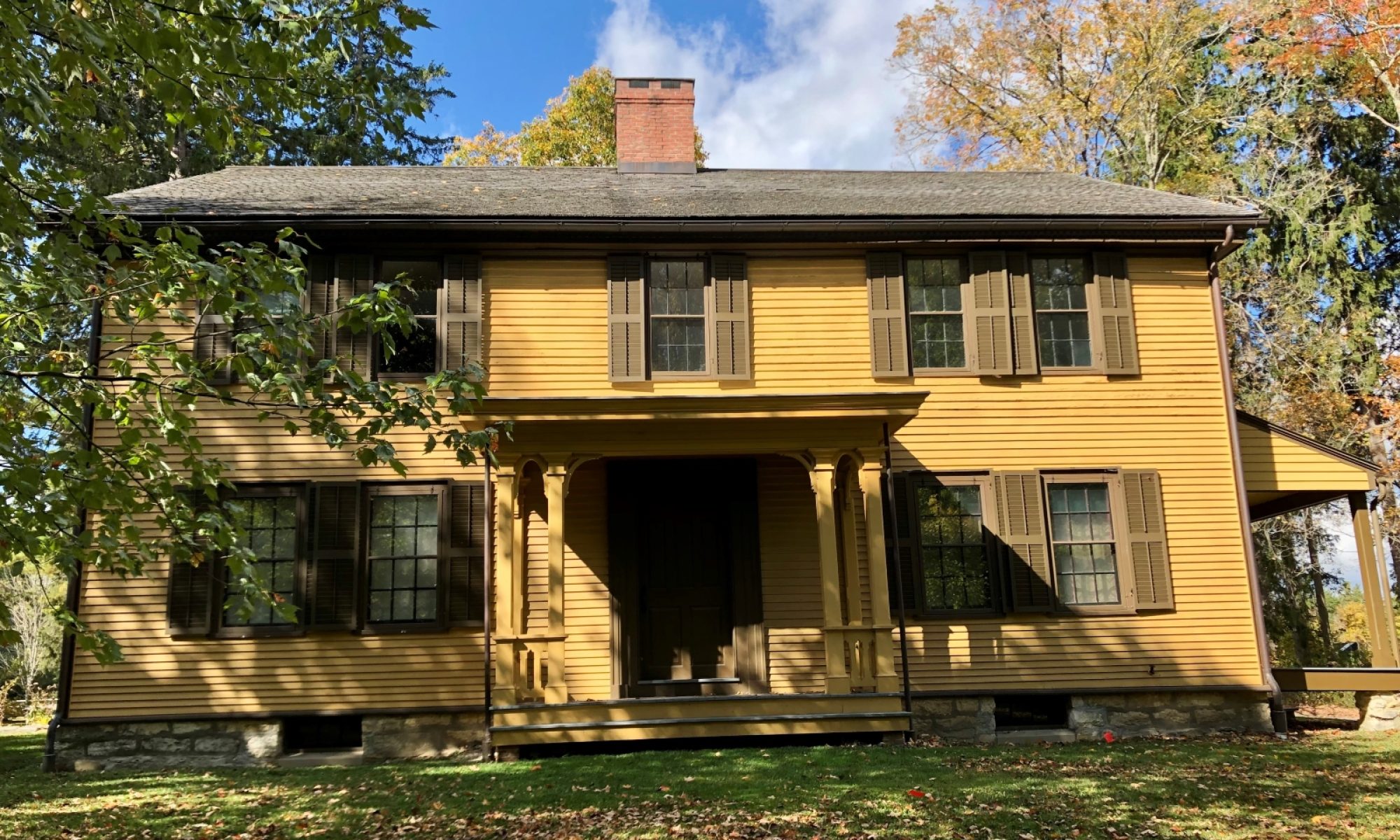
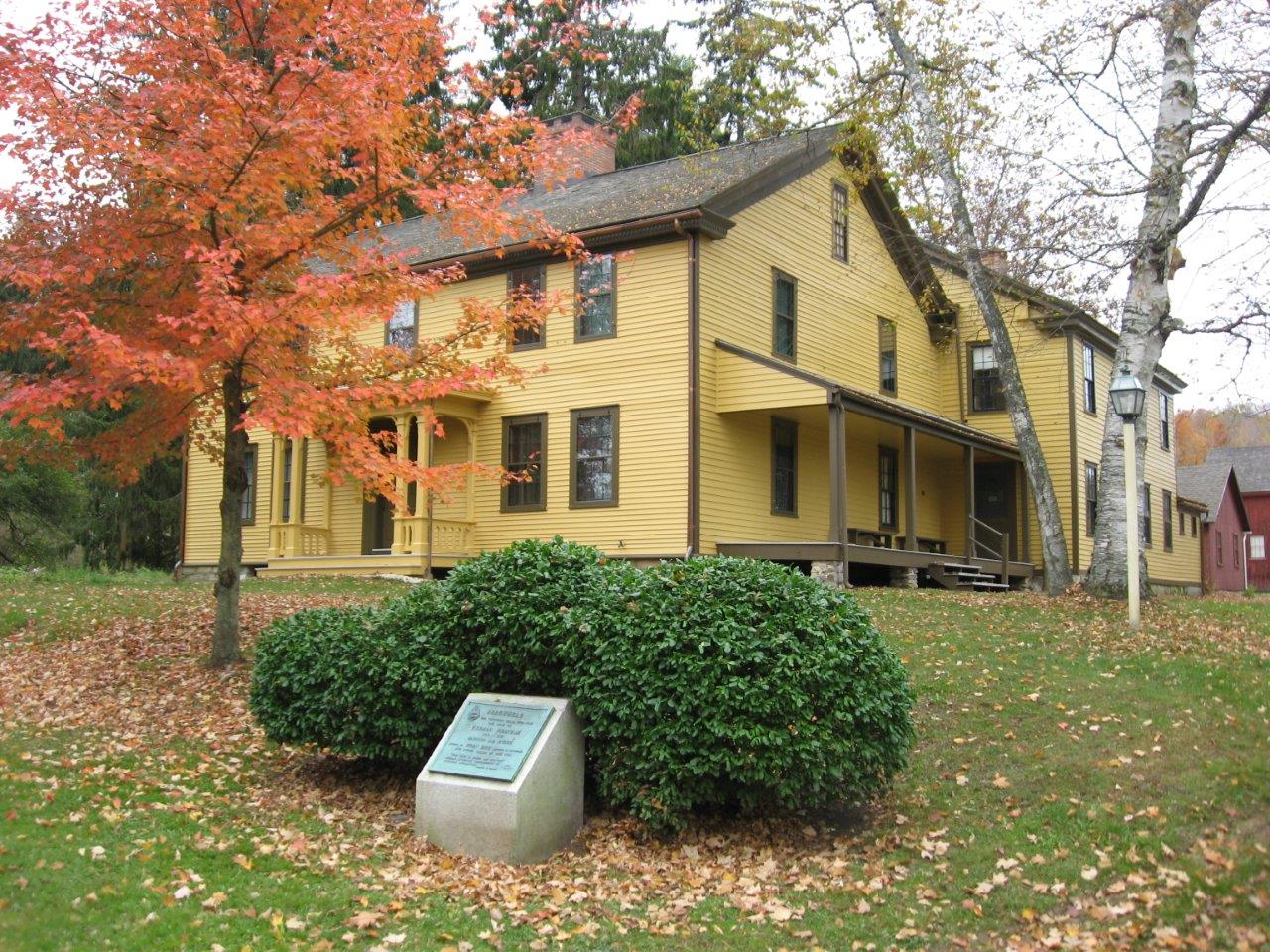
From 1850 to 1863 Melville and his large family called Arrowhead home. Built in 1780, Arrowhead was already an old house when Melville purchased it in 1850. While plowing his fields, he dug up arrowheads, left by their Mohican creators and he named his house for these relics. It was here he put pen to paper writing some of the most influential American fiction to date, including Moby-Dick, Bartleby The Scrivener, Pierre, and Benito Cerino, to name a few. Surrounded by nature, friends Nathaniel Hawthorne and Oliver Wendell Holmes, and inspired by his majestic views, Melville settled into domestic and professional peace if only for a time. His second floor professional study commands an inspiring view of Mount Greylock.
The house remained in the Melville family until 1927 when it left the family and remained a private residence until 1975 when Berkshire County Historical Society purchased it and opened it to the public as a museum. Arrowhead is a Registered National Historic Landmark.
Arrowhead
780 Holmes Road, Pittsfield, MA
413.443.1793
mobydick.org
Hancock Shaker Village
“…wagon – party – The Author, his wife & sisters Helen & Augusta drove North towards Hancock Mountain, visited the house of Jessee Potter… which is situated on the very summit…lunched at the old fashioned town of Hancock, & returned home by way of Lebanon & Hancock Shakers…28 miles.”
Augusta Melville
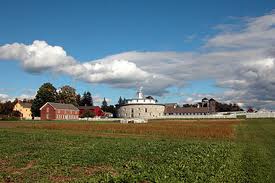
In 1790, a community of Shakers settled just west of Pittsfield. Melville first visited the Shakers in 1850 and returned many times to both the Hancock and Mount Lebanon Shaker communities, such as Nathaniel Hawthorne. Fascinated by their theology, these trips and interactions with the Shakers gave birth to Gabriel of the Jeroboam, a character in Moby-Dick. Hancock Shaker Village opened in 1961 and is a Registered National Historical Landmark and is the most comprehensively interpreted Shaker site in the world, and the oldest working farm in the Berkshires of Western Massachusetts. Hancock Shaker Village is a landmark destination of 750 acres, 20 historic Shaker buildings, and over 22,000 Shaker artifacts.
Hancock Shaker Village
P.O. Box 927
Pittsfield, MA
www.hancockshakervillage.org
Berkshire Athenaeum
In 1946, Dr. Henry A. Murray gave the Berkshire Athenaeum, Pittsfield’s public library, his private collection of Melville’s manuscript correspondence, first editions, family portraits, pictures, and personal items. The Melville Memorial Room opened in 1953, financed by Dr. Murray. Objects of interest include Melville’s writing desk, where he wrote Billy Budd, the tin breadbox that hid the manuscripts of Clarel and Billy Budd, Elizabeth Shaw Melville’s desk and personal objects.
The room remains today, having survived several library expansions. The room is open to the public any time the library is open. Special materials housed in the vault may be viewed by appointment only.
Berkshire Athenaeum
1 Wendell Ave.
Pittsfield, MA 01201
413.499.9496
www.pittsfieldlibrary.org

Crane Museum of Papermaking
“If the world was made entirely up of [magicians], I’ll tell you what I should do. I should have a paper-mill established at one end of the house, and so have an endless riband of foolscap rolling in upon my desk; and upon that endless riband I should write a thousand – a million – billion thoughts, all under the form of a letter to you.”
Melville to Hawthorne
Since the turn of the 19th century, Crane & Company has manufactured paper in Berkshire County, most famously for the U.S. treasury. Melville frequently purchased paper in both Lee and in Dalton at Carson’s Red Mill which was later purchased by Crane & Company. As one of the major industries in the county, Melville was touched by the lives of the mill girls, who he wrote about in The Paradise of Bachelors and the Tartarus of Maids.
In the winter of 1851, more than a year into Moby-Dick, Melville noted that he had purchased “a sleigh-load of paper” from the Crane paper mill.
The Crane Museum of Papermaking offers Pop Up Museums and outreach programming around Berkshire County, For information and to see the online archives visit www.cranemuseum.org.
The Crane Museum of Papermaking
Housatonic Street
Dalton, MA 01226
https://cranemuseum.org/
Tanglewood and Hawthorne Cottage
“…sat down in Love Grove to read my papers. While thus engaged, a cavalier on horseback came along the road, and saluted me in Spanish; to which I replied by touching my hat and returned to the newspaper. But the cavalier renewing his salutations, I regarded him more attentively and saw that it was Herman Melville!“
Nathaniel Hawthorne
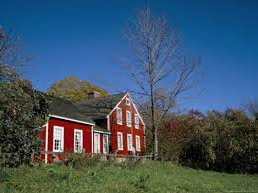
The Hawthorne Cottage is actually a replica of the original “Little Red House” that Hawthorne and his family moved into in 1850. During their 18 months in the cottage, Hawthorne completed The Wonder Book, The House of The Seven Gables and began the Tanglewood Tales. He also welcomed his friend Herman Melville several times to visit. The original cottage burned in 1890. The replica was built in 1947.
The Cottage is a private residence and not open for public viewing; however, during Tanglewood’s summer season, visitors can see the replica from the street.
Mt. Greylock
“…the great flood-gates of the wonder-world swung open, and in the wild conceits that swayed me to my purpose, two and two there floated into my inmost soul, endless processions of the whale, and, in mid most of them all, one grand hooded phantom, like a snow hill in the air.”
“There she blows!-there she blows! A hump like a snow-hill! It is Moby Dick!”
Moby-Dick, Herman Melville
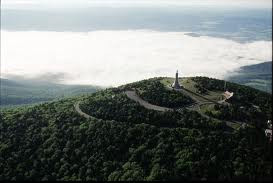
Massachusetts’ highest peak at 3,941 feet, Mt. Greylock served two purposes for Melville. He chose the Arrowhead home in part because of its views of the mountain, and also hiked and camped the area surrounding the mountain throughout his time here in the county. The Arrowhead view is also said to have reminded Melville as the cresting back of a whale – giving Moby-Dick a physical presence in Melville’s life. Melville added a “piazza” on the North side of the house because he felt that for a house to have such a view and no porch was “as if a picture gallery should have no bench.” He dedicated his novel, Pierre to the mountain.
Mt. Greylock is part of the Massachusetts state park system. There are 12,500 acres of wilderness. Hiking trails abound. Visitors can drive up the mountain, though the road is closed during the winter months.
The visitor center is located at 30 Rockwell Road, Lanesborough, MA. At its summit is Bascom Lodge, located at 3 Summit Road, Adams, MA 01220, and is open from May to October. Call 413-743-1591 for information about lodging and camping.
*-
Monument Mountain
“…one day it chanced that when they were out on a pic-nic excursion, the two were compelled by a thunder-shower to take shelter in a narrow recess of the rocks of Monument Mountain…They learned so much of each other’s character, and found that they held so much of thought, feeling and opinion in common, that the most intimate friendship for the future was inevitable.”
Joseph Smith, poet 1879 of the meeting of Hawthorne & Melville.
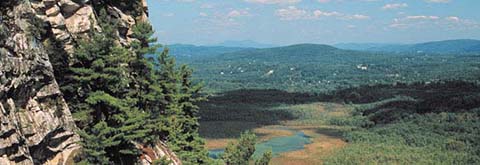
Rising 1,6*-42 feet, Monument Mountain is an enjoyable and vigorous hike. For almost two centuries, Monument Mountain has been a source of inspiration to poets, novelists, and painters. During William Cullen Bryant’s sojourn in Great Barrington (1815–1825), he penned “Monument Mountain,” a lyrical poem that tells the story of a Mohican maiden whose forbidden love for her cousin led her to leap to her death from the mountain’s cliffs. In the poem, Mohicans created a rock cairn on the spot where she lay buried, giving the mountain its name – Mountain of the Monument.
On August 5, 1850, Nathaniel Hawthorne and Herman Melville enjoyed a well-chronicled picnic hike up Monument Mountain. A thunderstorm forced them to seek refuge in a cave where a lengthy and vigorous discussion ensued, inspiring powerful ideas for Melville’s new book, Moby-Dick, which he dedicated to Hawthorne.
This now robust forest was at one time clear cut to supply fuel to several iron furnaces in the valley. Coal bush workers lived on the mountain for months at a time, tending their hearths. Flattened circular mounds scattered all over the mountain are a reminder of their labors. Often a birch tree grows near them to signal slow restoration of the soils.
Monum*-ent Mountain is on Route 7 in Great Barrington, MA.
A property of The Trustees of Reservations
413.298.3239
https://thetrustees.org/place/monument-mountain/
Park Square
“In truth, a man-of-war is a city afloat, with long avenues set out with guns instead of trees, and numerous shady lanes, courts, and by-ways. The quarter-deck *-is a grand square, park, or parade ground, with a great Pittsfield elm, in the shape of the main-mast at one end, and fronted at the other by the palace of the Commodore’s cabin.”
White Jacket, Herman Melville
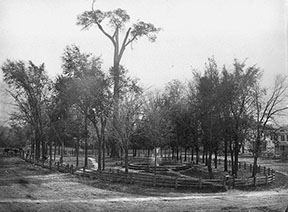
The site of the country’s first agricultural fair in 1810, Park Square has bound Pittsfield together since the early 18th century. As such, Melville’s life was forever touched by the square. St. Stephen’s, on the northeast side of the square, was where his sister, Kate was married in 1853, as was his sister, Helen the following year and the First Church of Christ Congregational, built in 1853, was where Melville himself attended services (sporadically). The old “Pittsfield Elm,” which stood until 1861, made an appearance in Melville’s novel White-Jacket.
In 2023, Berkshire County Historical Society along with the city of Pittsfield, planted a new Elm, to replace the famous Pittsfield Elm.
Park Square
1 Bank Row
Pittsfield, MA 01201
413.499.9370
Lenox Court House/Library
“In Token
Of My Admiration for his Genius,
This Book is Inscribed
To
NATHANIEL HAWTHORNE.”Moby-Dick, Herman Melville
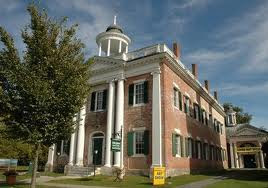
It was through this court that Herman’s uncle Thomas Melvill, Jr. was sentenced to debtor’s prison in the 1820s. Judge Lemuel Shaw, Herman’s father-in-law presided over this court. When the county seat was moved to Pittsfield in 1871, the courthouse was purchased by a private citizen intending to turn the courthouse into a library. The Lenox Library is located in this stately Greek Revival building which was designed by Captain Isaac Damon as the second Berkshire County Court House in 1815-1816, when Lenox was the Shire Town. The Lenox Library Association, incorporated in 1856, moved into this building in 1874, and the space has been operating as a library since that date. Added to the National Historic Register in 1973, the building was most recently renovated to its original grandeur in 2003-2004.
Today the building serves as the Lenox Library. Next to it is the former Curtis Hotel. It was at the Curtis in 1850, that Herman dined with Hawthorne and presented him with the first copy of Moby-Dick, which Melville dedicated to Hawthorne.
Lenox Court House/Library
18 Main Street
Lenox, MA 01240
413.637.0197
*-
October Mountain
Melville is credited with giving this mountain its name. An avid hiker and camper, Melville knew the natural landscape of the Berkshires well. He incorporated his knowledge of the area in many of his writings. In “Cock-a-Doodle-Doo!” Melville wrote about a “very lonely part of the country, a densely-wooded mountain on one side (which I call October Mountain on account of its bannered aspect in that month.)” October Mountain can be seen from the top of the hill at Arrowhead. The mountain is part of the State Forest system and includes many hiking trails.
October Mountain
Woodland Road
Lee, MA 01238
413.243.1778

Pontoosuc Lake
“Crowning a bluff where gleams the lake below,
Some pillared pines in well-spaced order stand
And like an open temple show.
And here in best of seasons bland,
Autumnal noon-tide, I look out
From dusk arcades on sunshine all about…”“Pontoosuce,” Herman Melville
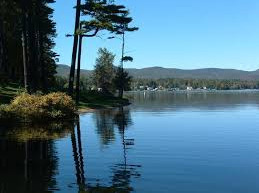
By the mid 19th century, Pontoosuc (the Mohican’s original name for what is now Pittsfield) was already a recreational area when Melville and his family moved to the Berkshires in 1850. Melville went on several fishing excursions there at the 511 acre great pond. Late in his life, Melville published a poem about the lake entitled “Pontoosuce.” It is now a public park, open for recreation.
Pontoosuc Lake
Corner of North Street and Hancock Road
Pittsfield, MA 01201
Balance Rock
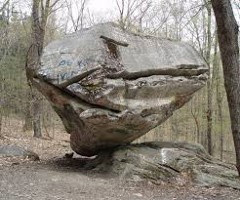
“…it was a breathless thing to see. One broad haunched end hovered within an inch of the soil, all along to the point of teetering contact; but yet touched not by soil.”
Pierre, Herman Melville
Created by glaciers, Balance Rock was a tourist destination even in Melville’s day. At that time it stood in an open field; today it is surrounded by woods. This hidden park in Massachusetts features a massive boulder that seems to defy the laws of physics. Located in Pittsfield and Lanesborough, Massachusetts. Balance Rock State Park is actually part of the Pittsfield State Forest, a sprawling woodland of more than 11,000 acres. The park is named after the true natural oddity – a 165-ton boulder that appears to be precariously balanced on top of a slab of bedrock. This massive stone is 30 feet long, 15 feet wide, and looks as if the slightest breeze might knock it from its perch. It is reported that Melville took friends to visit and dared them to lie beneath the boulder.
Balance Rock
Balance Rock Road
Lanesborough, MA 01237